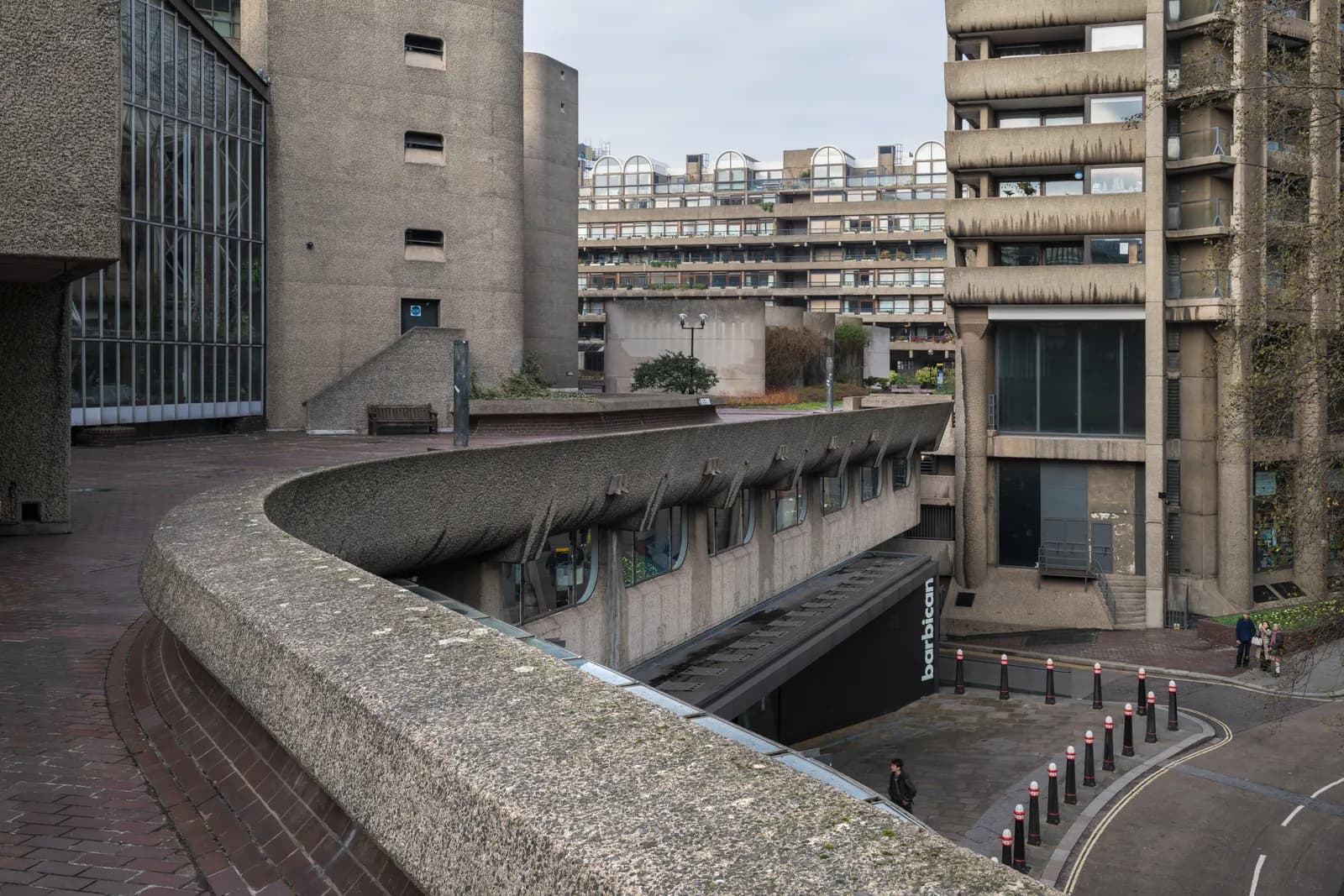
Tucked within the Square Mile, the Barbican Estate stands as one of London's most distinctive architectural achievements. Built on land devastated by Second World War bombing, the estate has evolved from controversial concrete monolith to Grade II listed landmark and Europe's largest multi-arts venue.
From Blitz Ruins to Architectural Statement
The site now occupied by the Barbican was among the most heavily bombed areas of London during the Blitz. Cripplegate, the medieval ward that once thrived here, was reduced to rubble. In the post-war era, the City of London Corporation sought to rebuild, commissioning architects Chamberlin, Powell and Bon to create a residential and cultural complex unlike anything Britain had seen.
Construction began in 1965 and continued for over a decade. The result was a 35-acre estate comprising more than 2,000 flats, the Barbican Centre, the Guildhall School of Music and Drama, and the City of London School for Girls. The architects embraced Brutalism, favouring raw concrete, geometric forms, and elevated walkways that separated pedestrians from traffic.
A Controversial Beginning
When Queen Elizabeth II opened the Barbican Centre in 1982, she described it as "one of the modern wonders of the world." Not all Londoners agreed. Critics dismissed the complex as foreboding, labyrinthine, and oppressively grey. Wayfinding within the estate became notorious; newcomers frequently reported losing their bearings amidst the highwalks, podiums, and identical concrete facades.
The residential towers, Shakespeare, Cromwell, and Lauderdale, briefly held the distinction of being the tallest residential buildings in Europe. Their fortress-like appearance, intended to create a tranquil enclave above the City's bustle, struck many as austere rather than inviting.
Critical Reassessment and Heritage Recognition
Attitudes shifted gradually. Architectural historians began recognising the Barbican's coherence and ambition. The estate's integration of arts, education, and housing within a pedestrian-focused environment anticipated contemporary urban planning principles. In 2001, the entire complex received Grade II listed status, protecting its distinctive character.
The Barbican Centre itself underwent significant refurbishment between 2005 and 2007, costing approximately £35 million. The improvements addressed long-standing criticisms about accessibility and signage whilst preserving the original architectural vision. New entrances, better lighting, and clearer wayfinding made the venue more welcoming without compromising its Brutalist character.
The Centre Today
The Barbican Centre now attracts over 1.1 million visitors annually to its concerts, theatre productions, film screenings, and art exhibitions. It houses the London Symphony Orchestra and the BBC Symphony Orchestra, maintaining the City of London's centuries-old musical traditions. The Barbican Art Gallery presents major exhibitions ranging from contemporary photography to Renaissance painting.
The estate's residential component remains highly desirable. Flats within the Barbican command premium prices, with residents enjoying access to private gardens, a swimming pool, and tennis courts. The once-derided concrete architecture now features in design magazines and Instagram feeds, emblematic of Brutalism's rehabilitation.
The Conservatory Oasis
Less heralded but equally distinctive is the Barbican Conservatory, occupying the estate's top floor. Opened in 1984 within the former Shakespeare Tower podium, it houses over 1,500 species of plants and trees from tropical and arid climates. Admission is free, offering City workers and visitors a verdant retreat from the surrounding glass and steel towers.
The conservatory operates as a managed research facility rather than merely ornamental space. Horticultural staff maintain rare specimens and propagate endangered species. Its fish-filled ponds and towering palms create an unexpected microclimate within one of London's densest districts.
Legacy and Influence
The Barbican's influence extends beyond its boundaries. Its successful integration of high-density housing with cultural amenities informed subsequent developments across London. The recent trend toward "placemaking" in urban regeneration owes something to the Barbican's example, however imperfect its execution.
For the City of London specifically, the Barbican represents a commitment to culture within a district primarily associated with finance. The Corporation of London, which owns and operates the estate, has demonstrated sustained support for the arts despite the Square Mile's commercial character. This dual identity, commerce and culture coexisting within ancient boundaries, defines the modern City.
The Barbican's transformation from reviled concrete fortress to beloved cultural landmark offers lessons about architectural patience. Buildings, like cities, require time to settle into their context. What seemed alien in 1982 appears essential in 2025, a reminder that the Square Mile's identity encompasses far more than its financial institutions.