The City of London stands apart. Within its 1.12 square miles lies a place where medieval ceremony meets global finance; where Roman foundations support modern skyscrapers; where 15,000 residents share their streets with more than 500,000 daily workers. This is the Square Mile, and this is your magazine.
A City Within a City
The City of London is not merely a district of the capital. It is a ceremonial county and local government district in its own right, governed by the City of London Corporation, officially titled "the Mayor and Commonalty and Citizens of the City of London". Its liberties are guaranteed by Magna Carta itself, clause IX having specifically protected the City's ancient rights since 1215.
The Corporation's constitution is unique in Britain. The first recorded royal charter dates from around 1067, during the reign of William the Conqueror, and can be altered only by Act of Common Council. The City's governance includes 25 wards, each electing one alderman and a number of common councilmen. Most distinctively, the City maintains a business franchise that allows companies to appoint voters based on employee numbers; businesses with fewer than ten workers appoint one voter, whilst those with more than fifty workers appoint ten plus one additional voter per fifty employees beyond the first fifty.
The Lord Mayor and Ancient Tradition
At the head of this ancient corporation stands the Lord Mayor of London, an office dating from 1189 when Henry Fitz-Ailwin became the first mayor. The title "Lord Mayor" was granted by Edward III in 1354. The 697th Lord Mayor, Dame Susan Langley, who prefers the style "Lady Mayor", took office on 7 November 2025. The post is held pro bono; the official residence is Mansion House on Queen Victoria Street, built between 1739 and 1752 to a Palladian design, its construction funded partly by fines on Nonconformists who refused Anglican sacrament.
The Lord Mayor's Show, held annually on the second Saturday in November, is a pageant dating from the sixteenth century. The Mansion House also hosts two significant political occasions: the Chancellor's annual Mansion House Speech each June, and the Prime Minister's address at the Lord Mayor's Banquet each November. Chris Hayward has served as Policy Chairman of the Corporation since 5 May 2022.
From Londinium to Financial Capital
The City's history stretches back nearly two millennia. The Roman settlement of Londinium was established around 47 AD, with defensive walls built between 190 and 225 AD. Alfred the Great resettled the walled area in 886, appointing Earl Æthelred to govern it. The Great Fire of 1666 destroyed much of the medieval City, leading to the reconstruction that produced many of its most recognisable landmarks.
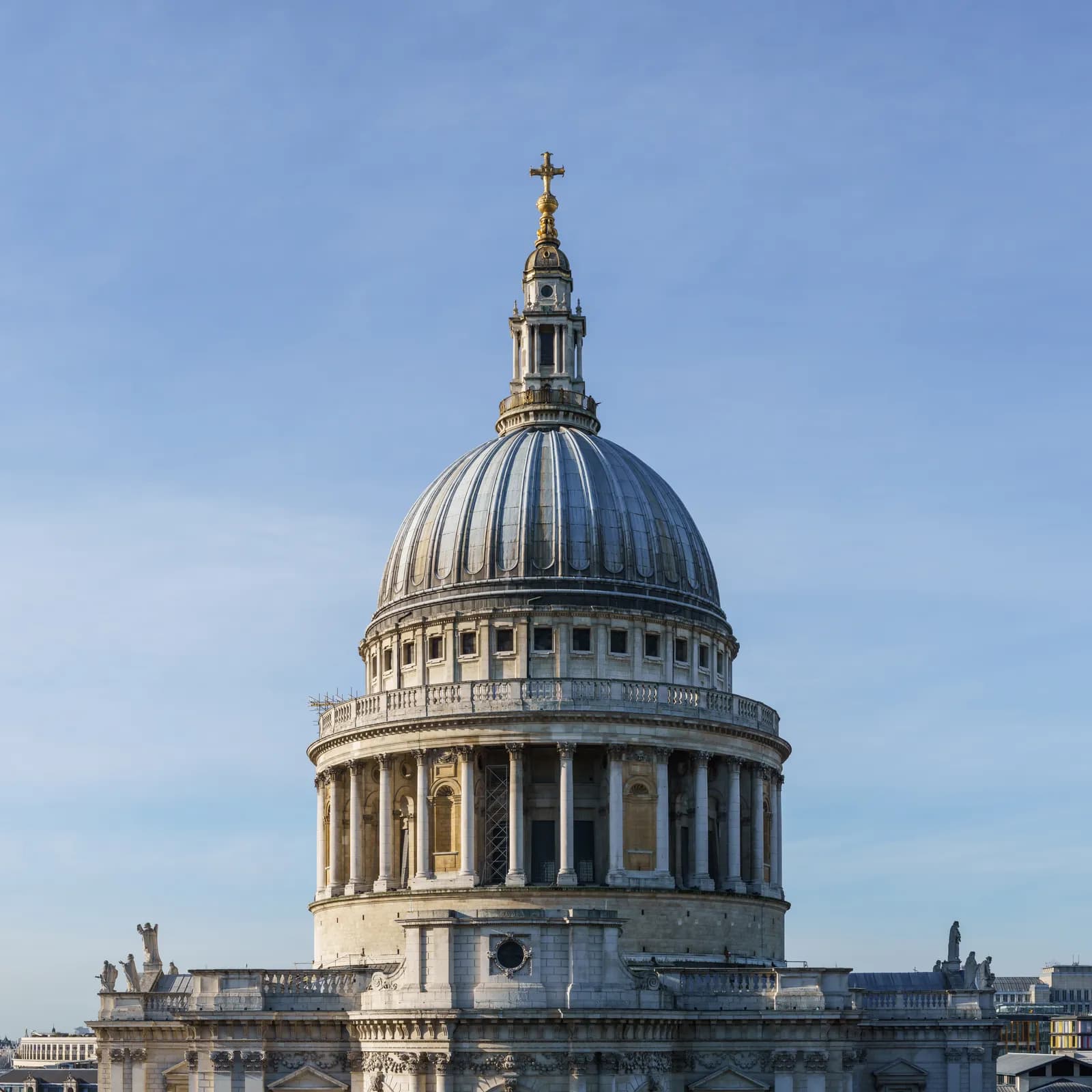
St Paul's Cathedral, Sir Christopher Wren's English Baroque masterpiece, was rebuilt between 1675 and 1710. At 365 feet (111 metres), its dome was the tallest building in London from 1710 until 1963 and remains the second-largest church in the United Kingdom by area. The cathedral was consecrated in 1697 and has witnessed royal weddings, state funerals, and national commemorations ever since.
Guildhall, the City's medieval great hall, occupies a site of even deeper history. The current building dates from 1411 to 1440 and incorporates the remains of a Roman amphitheatre beneath its foundations. The hall hosts the Lord Mayor's Banquet and other civic functions, whilst the Guildhall Art Gallery and Guildhall Library, holding London collections dating from the eleventh century, provide cultural resources to residents and visitors.
The Engine Room of Global Finance
Together with Canary Wharf and the West End, the City forms London's primary central business district and ranks among the world's leading financial centres. The Corporation's explicit role is to support and promote the United Kingdom's financial services industry.
The Bank of England, founded in 1694 and located on Threadneedle Street, serves as the central bank of the United Kingdom. Nearby stands the London Stock Exchange, founded in 1801 and now located in Paternoster Square. The Exchange lists more than 1,900 companies from over sixty countries and operates the FTSE 100 Index. Its market capitalisation stood at US$5.9 trillion by mid-2025, and it regained its position as Europe's largest stock market by total market value in 2024 and 2025. The FTSE 100 surpassed 10,000 points for the first time in early 2026.
The City has also established itself as the world's largest centre for mining capital, with sector market capitalisation of approximately US$600 billion, representing roughly thirteen per cent of the global mining market. The Exchange introduced the "Green Economy Mark" in 2019 to identify companies deriving at least fifty per cent of revenues from environmental products.
Policing and Protecting the Square Mile
The City of London Police, formed in 1839, is the smallest territorial police force in England and Wales, numbering 958 officers as of 2021. Despite its modest size, the force holds national responsibility as the lead force for fraud investigation since 2014, operating the National Fraud Intelligence Bureau. The force maintains a mounted unit and a special constabulary alongside its regular officers.
A Living Community
Beyond the financial institutions and historic buildings, the City remains a living community. The Barbican Estate provides significant residential accommodation within the Square Mile. The livery companies, numbering more than one hundred, maintain their medieval traditions alongside modern charitable and educational activities. The Freedom of the City, once a practical necessity for trading, continues as an honour granted to distinguished individuals.
Gog and Magog, the legendary giants who serve as symbolic guardians of the City, are represented by statues in Guildhall dating from 1953, replacing earlier figures destroyed in the Blitz.
The Corporation's most recent Common Council election was held in March 2025, demonstrating that this ancient city's democratic traditions continue into the present day. The City of London is not a museum piece, frozen in medieval amber. It is a dynamic, evolving place where history provides the foundation for contemporary significance. Whether you are a resident, a worker, or a visitor, the Square Mile rewards attention. City of London Magazine will be your companion in discovering what makes this place unlike any other.