The Lord Mayor's Show is the oldest surviving civic procession in the world, tracing its origins to a royal charter granted to the City of London in 1215. For more than eight centuries, the annual parade has wound through the Square Mile, interrupted only twice since its revival in 1655.
From Royal Charter to River Pageant
The office of Lord Mayor dates to 1189, when Henry Fitz-Ailwin de Londonestone became the first holder. The critical shift came in 1215, when King John granted a charter allowing the barons of the City of London to elect their own mayor annually; the condition was that each newly elected Lord Mayor must travel to Westminster to swear loyalty to the Crown. The title "Lord Mayor" itself was not used until 1354, when King Edward III granted it to Thomas Legge.
For much of its early history, the journey was made by barge on the River Thames, a custom that began with John Norman during his mayoralty in 1453. The river procession continued until 1856, when Thomas Quested Finnis made the final waterborne journey. A coach was introduced after 1711, when Lord Mayor Gilbert Heathcote was unseated from his horse by a drunken flower girl and broke his leg. The State Coach that remains in use today was commissioned in 1757 by Sir Charles Asgill at a cost of £1,065 0s 3d, roughly equivalent to £120,000 in modern terms.
Surviving Fire, Plague and War
The Show has continued through multiple outbreaks of plague, the Great Fire of London in 1666, city-wide riots and two world wars. During the First World War, the 1915 procession was repurposed as a recruiting event, with anti-aircraft guns and captured German weapons displayed along the route. In the Second World War, pageantry was reduced to a brisk military parade and the State Coach was packed away; nevertheless, the Lord Mayor still travelled to Westminster during the Blitz to pledge loyalty to the Crown.
Since the Show was revived in 1655 following a fifteen-year interruption caused by the English Civil War, it has been cancelled only twice: in 1852, to make way for the state funeral of the Duke of Wellington, and in 2020, because of the COVID-19 pandemic. The 800th anniversary was marked on 14 November 2015.
The First Women at Mansion House
For nearly eight centuries, the office was held exclusively by men. Dame Mary Donaldson broke that barrier in 1983, becoming the first female Lord Mayor. She had already been the first woman elected as an alderman, in 1975, and the first female Sheriff of the City of London, in 1981. Dame Fiona Woolf followed in 2013 as the second woman to hold the post.
In 2025, Dame Susan Langley was elected as the third woman to serve in more than 800 years, and the first to be styled the "Lady Mayor of London". Her inauguration on 8 November 2025 was billed as the first "Lady Mayor's Show", with more than 7,000 participants from around the world forming a procession of approximately three miles.
A Fixed Route Through the City
The modern route was established in 1952; before then, the procession varied each year to pass through the Lord Mayor's own ward. Since 1959, the Show has been held on the second Saturday in November. The procession begins at Guildhall, travels via Princes Street, Bank junction, Poultry, Cheapside, New Change, St Paul's Churchyard, Ludgate Hill, Fleet Street and the Strand to the Royal Courts of Justice, where the Lord Mayor swears allegiance. The return route runs along Aldwych, Essex Street, Temple Place, Victoria Embankment and Queen Victoria Street, concluding at Mansion House. The parade typically begins at about 11 am and concludes at approximately 3:30 pm.
The State Coach and Its Guard
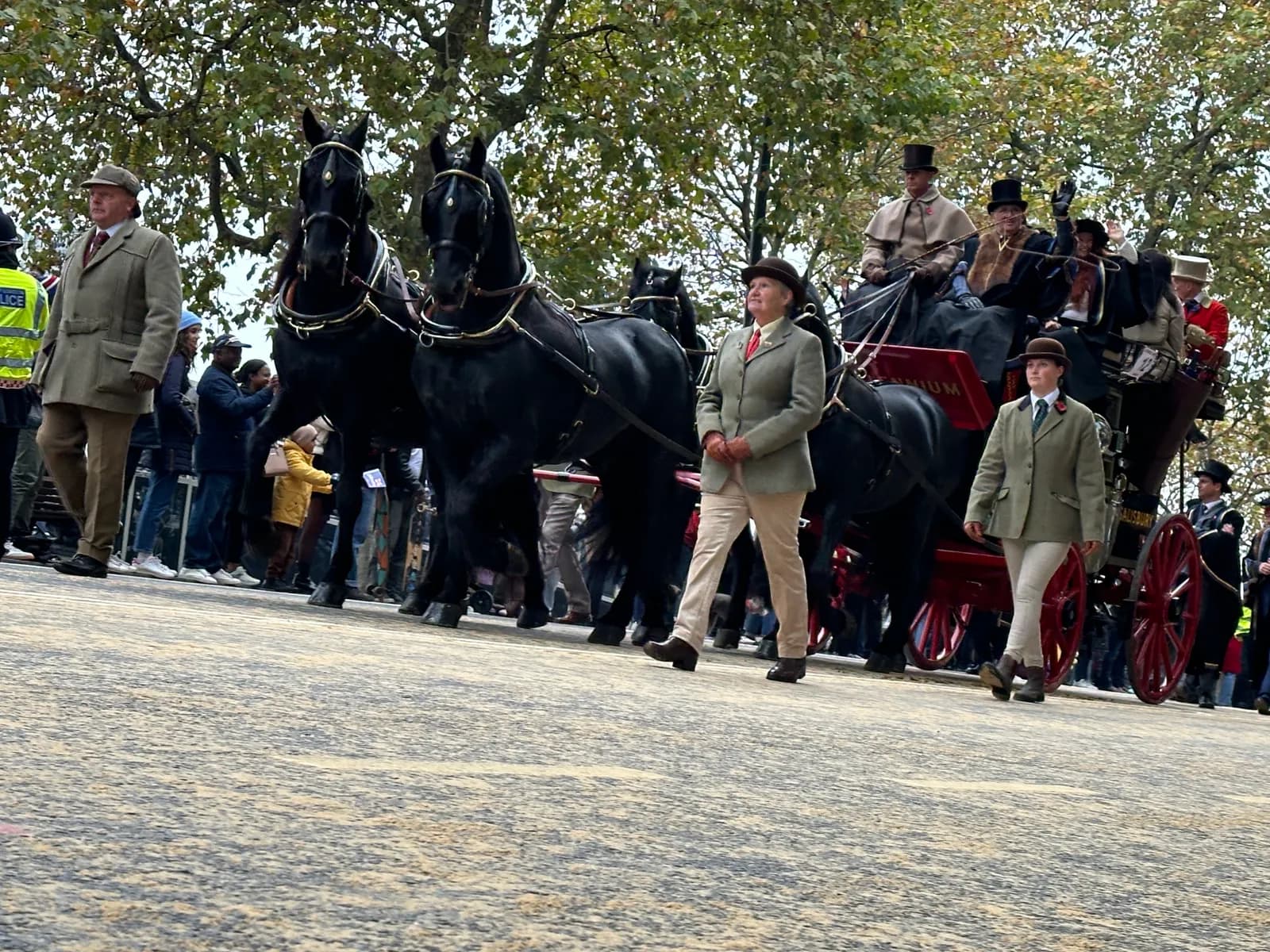
The Lord Mayor's State Coach was built in 1757 by Joseph Berry of Leather Lane, Holborn. It weighs 2.9 tonnes and measures 6.55 metres in length. The side panels were painted by Giovanni Battista Cipriani, who also worked on the monarch's Gold State Coach. Six shire horses pull the coach, attended by two postillions who are winners of the annual Doggett's Coat and Badge rowing race. The Company of Pikemen and Musketeers of the Honourable Artillery Company provides the escort.
Among the procession's regular features are Gog and Magog, two woven willow giant reproductions of statues in Guildhall, carried by volunteers from the Guild of Young Freemen. Dominic Reid OBE has served as Pageantmaster since 1992, orchestrating what the official website describes as "the largest unrehearsed procession in the world".
What Is Confirmed
The 1215 charter, the 1655 revival after the Civil War, the cancellations in 1852 and 2020, the first female Lord Mayor in 1983, and the 2025 Lady Mayor's Show are all documented. The State Coach's dimensions, the fixed route since 1952, and the second-Saturday-in-November scheduling are also verified.
What Is Unclear
Although sources state that the Show survived several outbreaks of plague and the Great Fire of London, the specific years in which plague disrupted the procession have not been precisely identified in the material reviewed. Similarly, detailed records of how the 1666 Show was conducted amid the aftermath of the Great Fire are not cited in the available sources.