Tucked away between Little Britain and Aldersgate Street, just a short walk from St Paul's Cathedral, lies a small City garden that most pedestrians hurry past without a second glance. Yet within Postman's Park stands one of London's most moving monuments: a memorial to everyday heroism that celebrates ordinary people who gave their lives to save others.
A Park Built on Burial Grounds
Postman's Park opened to the public on 28 October 1880, though its history stretches back considerably further. The land was formed from three former burial grounds: St Botolph's Aldersgate churchyard, which had served the parish since approximately 1050; Christ Church Greyfriars burial ground; and St Leonard, Foster Lane burial ground. The park expanded gradually over the following decade, incorporating the additional churchyards in 1887 and 1890.
The park takes its name from the postal workers at the General Post Office headquarters on St Martin's Le Grand, who made the green space their favourite retreat during lunch breaks. Despite the GPO building's closure in the early 20th century, the name has endured.
Visitors today may notice that the park sits significantly higher than the surrounding streets. This elevation is no architectural accident: a shortage of burial space in Victorian London meant corpses were frequently laid upon the ground and covered with soil, gradually raising the level over centuries of interments.
George Frederic Watts's Vision
The park's defining feature is the Memorial to Heroic Self-Sacrifice, the brainchild of Victorian artist and sculptor George Frederic Watts. In September 1887, Watts wrote to The Times proposing a memorial to commemorate ordinary heroes as part of Queen Victoria's Golden Jubilee celebrations.
"The material prosperity of a nation is not an abiding possession," Watts argued. "The deeds of its people are." He sought to recognise not statesmen or soldiers, but the overlooked heroism of everyday citizens: servants who rushed into burning buildings, labourers who saved drowning children, passers-by who intervened in moments of crisis.
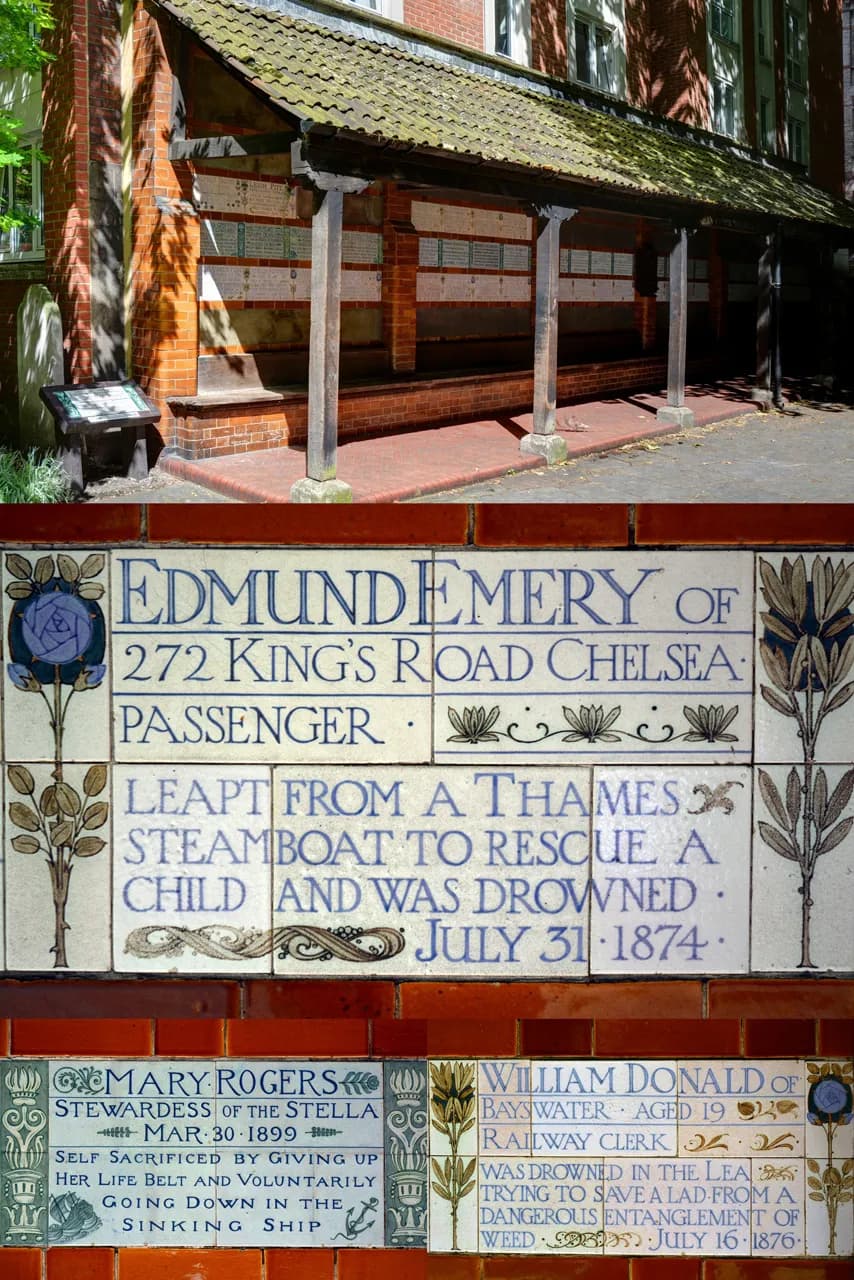
The memorial was unveiled on 30 July 1900 by the Lord Mayor of London, Alfred Newton, and the Bishop of London, Mandell Creighton. It takes the form of a 50-foot wooden loggia designed by architect Ernest George, with ceramic tablets mounted on a long wall behind.
The Stories on the Wall
Today, 54 ceramic tablets commemorate 62 individuals, though Watts originally envisaged space for 120. The tiles themselves represent two distinct artistic periods: the early tablets designed by William De Morgan in the Arts and Crafts style, and later additions by Royal Doulton featuring Art Nouveau influences.
Among those remembered is Alice Ayres, the daughter of a bricklayer's labourer who saved three children from a burning house in Union Street, Borough, in April 1885, losing her own life in the process. Watts specifically cited her case when first proposing the memorial. Her tablet reads simply: "By intrepid conduct saved 3 children from a burning house at the cost of her own young life."
Thomas Griffin, a fitter's labourer, died in April 1899 when a boiler exploded at a Battersea sugar refinery; he was "fatally scalded in returning to search for his mate." Mary Rogers, stewardess of the SS Stella, gave up her life belt to another passenger and "voluntarily went down in the sinking ship" in March 1899.
Henry James Bristow was just eight years old when, on 30 December 1890, he "saved his little sister's life by tearing off her flaming clothes but caught fire himself and died of burns and shock."
The most recent addition, installed in June 2009 after a 78-year hiatus, honours Leigh Pitt, a 30-year-old print technician who died saving a drowning boy from a canal at Thamesmead in June 2007. The tablet notes poignantly: "Saved a drowning boy from the canal at Thamesmead, but sadly was unable to save himself."
An Unfinished Monument
The memorial remains incomplete. Only four tablets were in place at its 1900 unveiling, with nine more added during Watts's lifetime. Following his death in 1904, his wife Mary Watts oversaw the installation of 35 further tablets before losing interest in the project, disillusioned with Royal Doulton's workmanship after De Morgan's retirement to become a novelist.
Between 1908 and 2009, only six additional tablets were installed, leaving 66 of the planned 120 spaces empty. The Friends of the Watts Memorial, established in 2015, now works to protect, preserve and promote the site, with ambitions to complete Watts's original vision.
Recognition and Access
The memorial was Grade II listed in 1972 and upgraded to Grade II* in 2018, reflecting its significance as both a work of art and a social document. The park itself is managed by the City of London Corporation and remains open to the public without charge.
The memorial gained renewed attention following the 2004 film Closer, which featured scenes shot within the park. Today, it attracts visitors seeking respite from the bustle of the surrounding financial district, many of whom pause to read the quietly devastating stories of courage recorded on its weathered tiles.
What distinguishes Postman's Park from other London memorials is precisely its humility. There are no grand statues of statesmen here, no military glory. Instead, the tablets remember a pantomime artist who died saving a colleague from a tiger, a railway worker who was crushed preventing a train collision, and countless other ordinary Londoners who faced extraordinary moments with unthinking bravery.