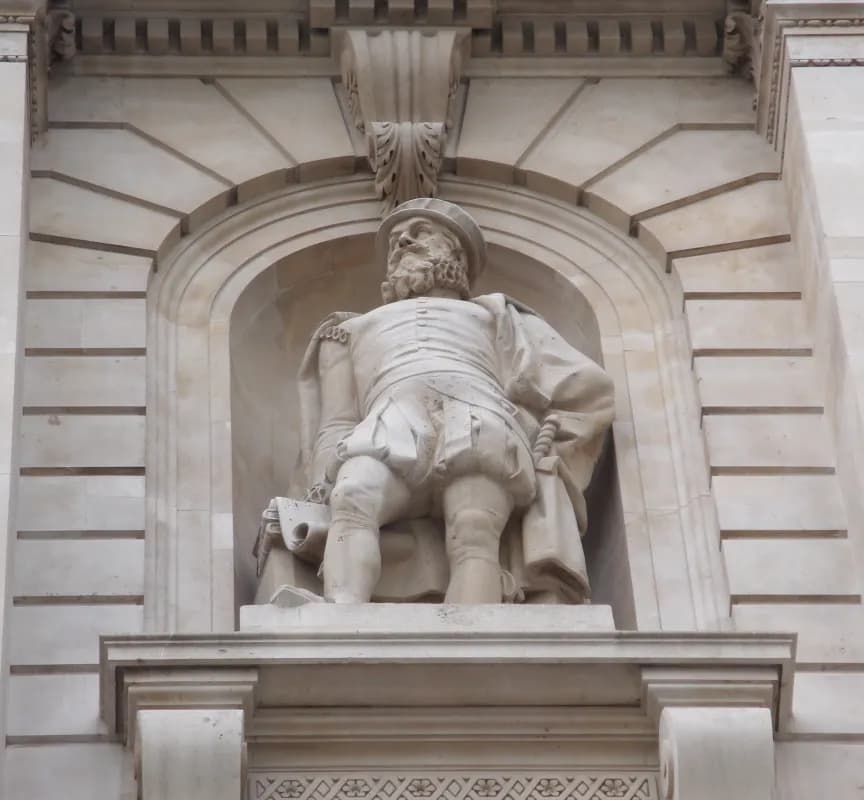
The Tudor merchant and royal financier Sir Thomas Gresham (c. 1519–1579) created the physical and institutional foundations that established the City of London as Europe's centre of international commerce. His founding of the Royal Exchange and Gresham College left a legacy that continues to shape the Square Mile nearly five centuries later.
Early Years in the Mercers' Company
Gresham was born in London around 1519 into a prominent merchant family. His father, Sir Richard Gresham, had served as Lord Mayor of London and been knighted by Henry VIII. The younger Gresham was educated at St Paul's School and Gonville and Caius College, Cambridge, while simultaneously apprenticed to his uncle Sir John Gresham in the Mercers' Company.
He was admitted to the Mercers' Company as a liveryman in 1543 at the age of 24. The Mercers were, and remain, the premier livery company in the City; their membership has included figures from William Caxton and Sir Thomas More to Winston Churchill. This connection provided Gresham with both trade regulation and the social capital essential for his later financial innovations.
Financier to Three Monarchs
Gresham's principal work for the English Crown began in 1551 under Edward VI, when he was called upon to advise on the realm's financial embarrassment following the mismanagement of Sir William Damsell. Gresham advocated ingenious methods to raise the pound sterling's value on Antwerp's Stock Exchange, which allowed Edward VI to discharge almost all debts. For this service, he received grants of lands worth approximately £400 per annum.
Under Mary I, Gresham briefly fell from favour and was replaced by Alderman William Dauntsey. He was reinstated when Dauntsey's operations proved unsuccessful, receiving a salary of 20 shillings per day plus grants of church lands worth £200 annually.
Elizabeth I continued his service, appointing him Knight Bachelor in 1559 and later as Ambassador Plenipotentiary to Duchess Margaret of Parma. He also served a more unusual Crown duty: acting as gaoler to Lady Mary Grey, imprisoning her first in his Bishopsgate townhouse and later at Osterley Park from 1569 to 1572.
The Royal Exchange: London's Commercial Heart
In 1565, Gresham proposed to the City of London's Court of Aldermen that he would build a purpose-built commercial exchange at his own expense. Modelled on the Antwerp bourse he knew from his trading years in the Low Countries, the building would serve as Britain's first specialist commercial centre. The City Corporation and the Worshipful Company of Mercers provided the site at the junction of Cornhill and Threadneedle Street, where they still hold the freehold jointly.
The exchange opened on 23 January 1571 with a ceremony attended by Queen Elizabeth I, who granted it the "royal" title and a licence to sell alcohol and valuable goods. The golden Gresham grasshopper that surmounted the building's weathervane became an enduring symbol of the City; at 11 feet long and 177 feet above street level, it remains one of the Square Mile's most distinctive landmarks.
Gresham obtained a yearly rental of £700 from the shops in the upper part of the building. The original structure was destroyed in the Great Fire of London in 1666; the second building opened in 1669 and the current structure, designed by Sir William Tite, opened on 28 October 1844. Today the Royal Exchange houses luxury retail and dining, but its location at Bank junction remains the symbolic centre of London's financial district.
Bishopsgate and the City Merchant's Life
Gresham's principal London residence was his townhouse on Bishopsgate Street, which served not only as his family home but as a prison for state detainees. The site is now occupied by Tower 42, formerly the NatWest Tower. His country estate at Osterley Park in Hounslow and Norfolk property at Intwood Hall complemented his City base.
Following his death on 21 November 1579, reportedly from apoplexy, he was interred at St Helen's Church, Bishopsgate. The church, sometimes called the "Westminster Abbey of the City" for its numerous monuments, survived both the Great Fire and the Blitz. His altar tomb remains there today.
Gresham College: Public Learning for London
Through his will, Gresham established an institution of higher learning that endures as his most direct legacy to the City's intellectual life. He bequeathed the bulk of his property; estates in London and across England yielding more than £2,300 annually; to his widow, with the provision that after her death, his Bishopsgate house and the rents from the Royal Exchange would pass to the Corporation of London and the Mercers' Company to found Gresham College.
The college opened in 1597, its first seven professors appointed to lecture each day of the week on astronomy, geometry, physic, law, divinity, rhetoric, and music. This curriculum reflected the medieval university structure, the trivium and quadrivium, but with a crucial innovation: the lectures were free and open to all.
The college's early success contributed to the incorporation of the Royal Society in 1660; many of the Society's early meetings were held at Gresham College. Notable professors included Sir Christopher Wren in astronomy and Robert Hooke in geometry from 1665 to 1704.
The college remained at Gresham's Bishopsgate mansion until 1768, then occupied various sites before settling at Barnard's Inn Hall, Holborn in 1991. It continues to provide over 140 free public lectures annually, with an archive of more than 2,000 lectures online that has attracted 54 million YouTube views.
Gresham's Law and Currency Stability
The economic principle known as "Gresham's Law"; that bad money drives out good; was named after him in 1857 by economist Henry Dunning Macleod. However, the concept had been recognised earlier, including by Nicolaus Copernicus in 1519.
Gresham's actual contribution was practical rather than theoretical. Following the debasement of English currency by Henry VIII and Edward VI, he urged Queen Elizabeth to restore the coinage. In a letter to the Queen in 1558, he observed "that good and bad coin cannot circulate together" and noted that "all your fine gold was conveyed out of this your realm" due to the debasement.
Enduring Legacy in the Square Mile
The City of London preserves Gresham's memory in its street names and institutions. Gresham Street, created in 1845 by widening and combining Cateaton Street, Maiden Lane, St Anne's Lane, and Lad Lane, runs east from St Martin's Le Grand past the Guildhall and Bank of England.
His golden grasshopper crest remains the emblem of Gresham College and continues to surmount the Royal Exchange. It has even crossed the Atlantic: a copy adorns Faneuil Hall in Boston, Massachusetts.
Gresham's model of combining merchant trading with sophisticated financial services to the Crown, operating across London and Antwerp to manage England's international credit, established a template for the City's later development. His founding of the Royal Exchange created the physical infrastructure that anchored London's rise as a global financial centre, while Gresham College established a model of public education that continues to offer free learning to Londoners today.