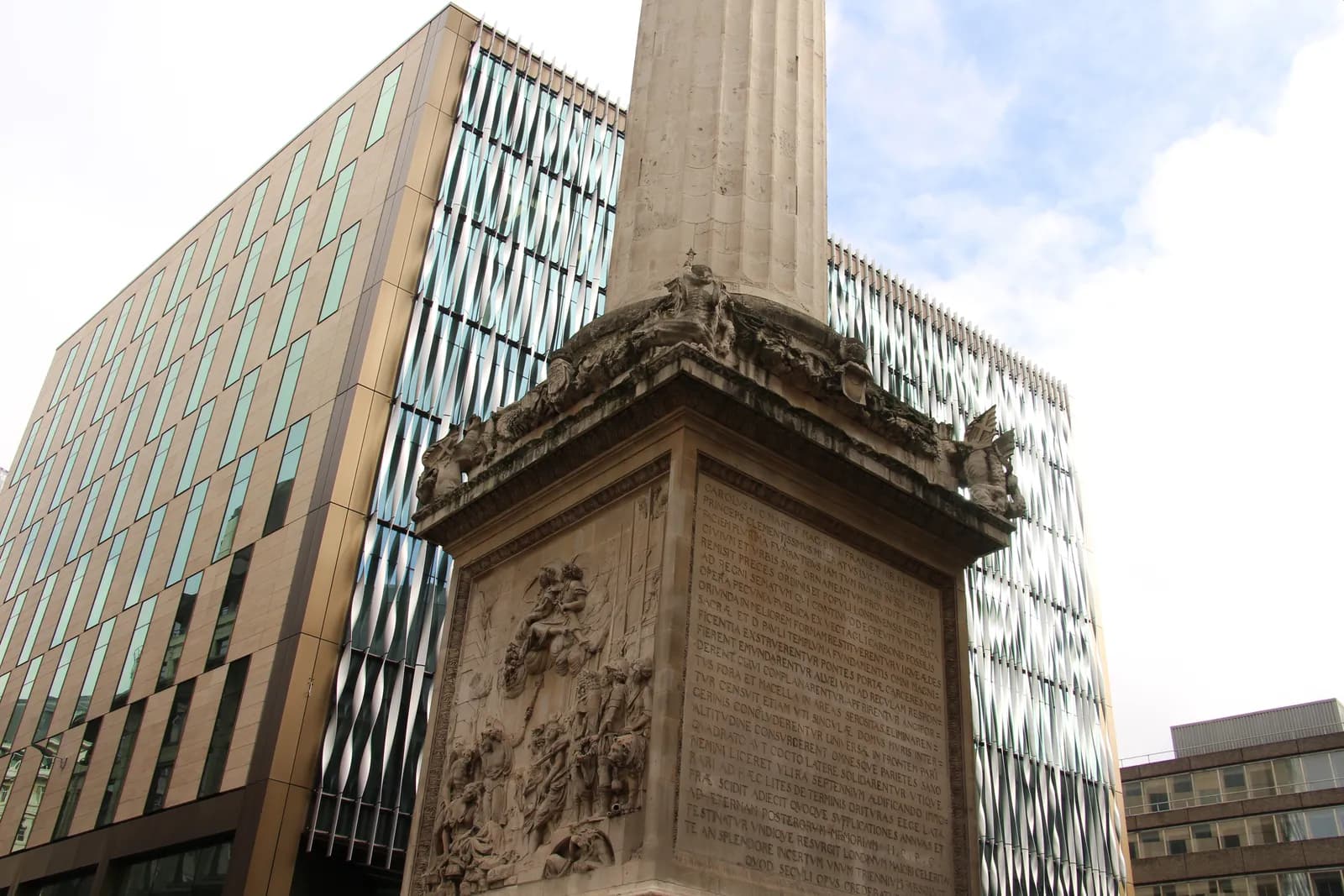
The Monument to the Great Fire of London stands as both a memorial and a forgotten scientific instrument. While Sir Christopher Wren is often credited as its sole architect, his collaborator Robert Hooke designed the structure with a hidden purpose: to conduct groundbreaking experiments in the heart of the City.
The Dual-Purpose Design
The Monument rises 202 feet (61.5 metres) at Fish Street Hill, its height precisely matching the distance to the Pudding Lane bakery where the Great Fire began on 2 September 1666. Constructed between 1671 and 1677 from Portland stone, the Doric column features a hollow central shaft measuring 18 feet (5.5 metres) at its base. This architectural peculiarity was no accident. Hooke, who served as Surveyor to the City of London following the fire, engineered the column specifically to accommodate scientific apparatus.
The design cost £13,450 9 shillings and 6 pence, an investment that funded what the City of London Corporation now acknowledges was a covert research facility. Beneath the base lies a small vaulted chamber that functioned as Hooke's underground laboratory, where he prepared experiments and stored equipment away from public view.
Pendulum Experiments in the Shaft
Hooke's most significant work at the Monument involved suspending pendulums up to 200 feet long within the hollow shaft. These experiments allowed him to measure oscillation periods with unprecedented precision, calculating gravitational acceleration. He sought to determine the Earth's density by comparing his Monument observations with data from other latitudes. The Royal Society, where Hooke served as Curator of Experiments from 1662 until his death in 1703, documented these investigations as foundational contributions to physics.
Astronomical Observations Above the City
The viewing platform, accessible via 311 spiral steps, provided Hooke with one of the tallest vantage points in 17th-century London. He installed telescopes in the gallery to conduct celestial observations, capitalising on the column's height to achieve clearer views above the smoke and clutter of the rebuilding city. The golden orb summit, measuring 18 inches in diameter, marked the highest point of this scientific perch.
Air Pressure and Atmospheric Measurements
Beyond pendulum and telescope work, Hooke utilised the shaft's vertical height to conduct air pressure experiments. The substantial elevation change between the underground chamber and the viewing platform enabled him to measure atmospheric variations, contributing to the emerging understanding of barometric pressure in Restoration England.
A Hidden Legacy
The Monument's dual existence as both public memorial and private laboratory remained largely obscured from contemporary Londoners. While visitors climbed the steps to view the flames emerging from the copper urn summit, few realised the structure's role in advancing scientific knowledge. Britannica's historical records describe this concealed function as a "secret laboratory," highlighting the tension between commemoration and inquiry in the 17th century.
Visiting Today
The Monument remains open to visitors daily from 9:30am to 6pm, with last admission at 5:30pm. Admission costs £6 for adults, £4 for children under 16, and £5 for concessions. The 311-step climb remains the only access route; there is no lift. Those who reach the viewing platform are rewarded with 360-degree views extending up to 20 miles on clear days, standing precisely where Hooke once positioned his telescopes to study the heavens above the City of London.